

As a photographer or photography enthusiast, a tripod quickly becomes part of your daily kit—even if you sometimes take it for granted. This three-legged tool offers huge benefits for shooting, especially in terms of keeping your shots rock-steady. There are numerous creative ways to use your tripod for outstanding quality photos, from achieving unique angles to executing long-exposure or overhead shots.
This detailed post will share some inventive tripod techniques to help elevate your photography. You may already be familiar with some methods, while others could be entirely new. Read on and be sure to take in each tip for maximising your tripod’s potential.
- Use it as a hand-held stabiliser.
Hold the tripod by its middle section and extend its legs. This gives you a stable base for handheld shooting, especially useful when capturing photos from various angles, such as a top-down view. It also helps you maintain a secure grip on the camera while shooting.
Although holding a tripod in your hand may seem unusual, trying this method will show you how much easier shooting can become. It’s particularly handy in crowded places where it helps prevent the tripod from being bumped by others, allowing you to shoot photos while keeping the tripod in your hands.
- Switch off the image stabilisation feature
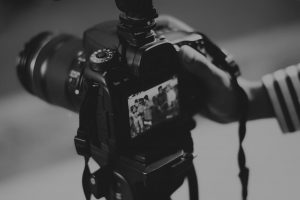
When using a tripod, it is advisable to switch off the image stabilisation feature on your camera or lens if it has one. Image stabilisation is designed to counteract small movements during handheld shooting, but when the camera is fixed on a tripod, this feature can cause minor vibrations or micro-movements. These can lead to blurred images or reduced sharpness in your shots. The stability provided by the tripod alone is sufficient, so relying on its steadiness without image stabilisation will give you the best possible results. Some newer systems do have tripod-detection capabilities that automatically disable stabilisation when the camera is steady, but if your camera lacks this feature, it is best to switch off stabilisation manually for optimal image clarity and sharpness. This is especially important during long exposure photography where even the smallest movement can impact the image quality.
- Make use of the mirror-lock feature on the tripod.
The mirror inside a digital camera moves to clear the path for the lens when you take a photo. However, this movement can cause slight vibrations, which may affect image sharpness. To reduce this, many cameras offer a mirror lock-up feature. When enabled, the mirror flips up and stays in place before the shutter opens, preventing vibrations caused by the mirror’s movement during the exposure.
This feature is particularly useful when shooting on a tripod, especially with long lenses or during long exposure photography. At faster shutter speeds, the vibrations from the mirror movement can be more noticeable in photos, so using mirror lock-up can help improve sharpness. Even though the shaking might be less visible at slower shutter speeds, enabling mirror lock-up is generally recommended to avoid any potential blur.
While some photographers find mirror lock-up essential for achieving the sharpest images, especially in landscape and night photography, others note that with very sturdy tripods, the difference may be minimal. Nonetheless, using mirror lock-up combined with a solid tripod and, if possible, a remote shutter release or timer, is a reliable way to minimise vibration and ensure the best image quality.
- Use the tripod as a shoulder rig
You can use your tripod as a makeshift shoulder rig if you don’t have a dedicated one available. To do this, place the tripod across your shoulders and extend its legs for balance and support. Position your camera as needed, and you’re ready to shoot. This method provides extra stability and comfort, making it easier to hold the camera steady, especially when you need mobility or are shooting in less accessible locations. It’s a simple, effective hack that leverages equipment you already have to improve your shooting experience.
- Capturing low angle shots
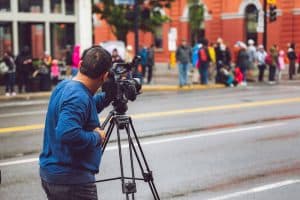
To capture a low angle shot without getting down to the ground, you can adjust your tripod accordingly. One effective method is to invert the tripod’s center column (if your tripod allows) so the camera can be positioned very close to the ground. Alternatively, set the tripod legs wide and keep them close to the ground to achieve a low shooting angle. These adjustments stabilize your camera at a low level, letting you shoot steady and beautiful shots without needing to lower yourself physically. This technique is especially helpful for shooting interesting textures, reflections, or dynamic perspectives while maintaining tripod stability.